
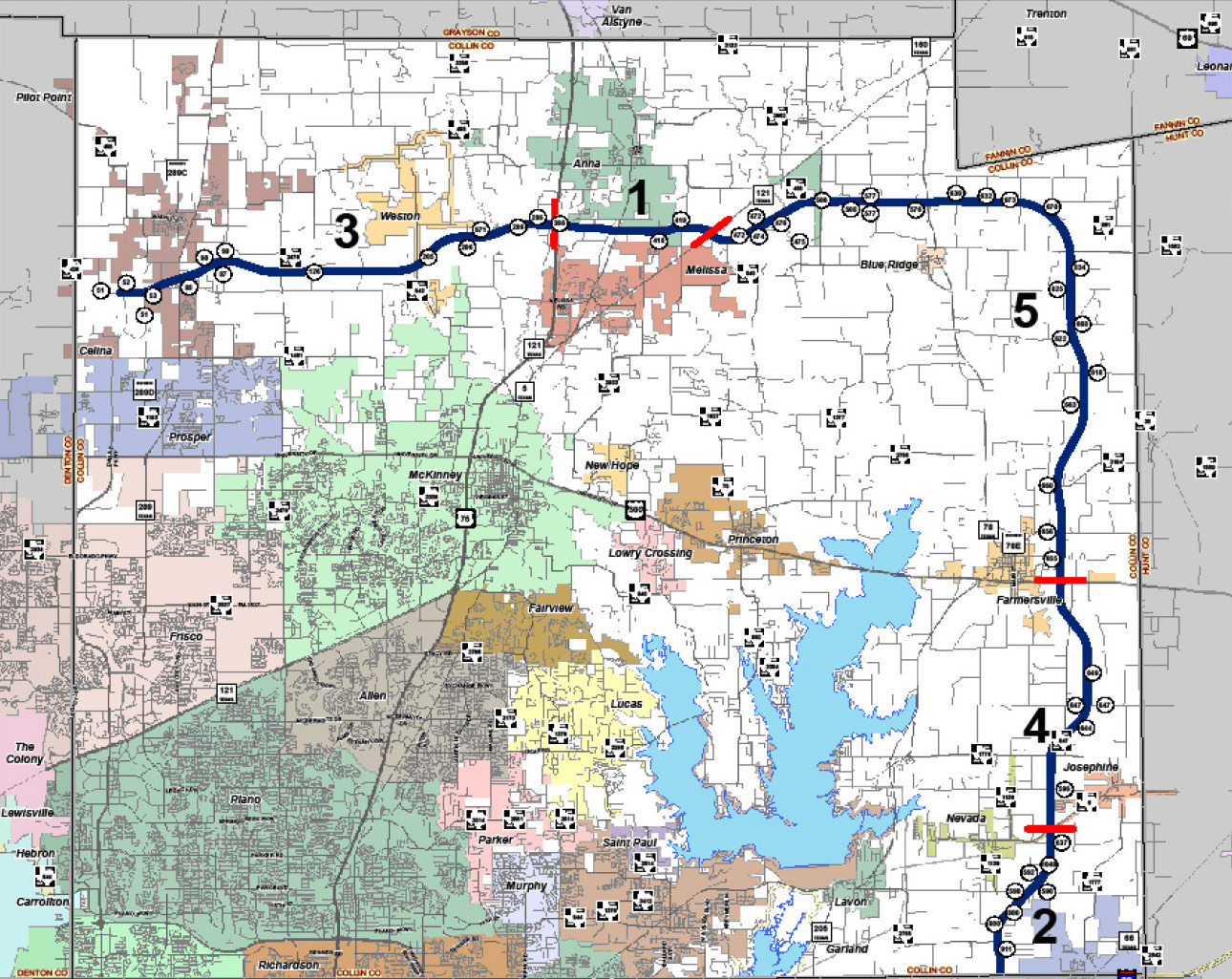
New Location Controlled Access Corridor Through Rapidly-Growing North Texas
Alignment Studies Through Final Design for an 8-Mile Regional Thoroughfare
BGE conducted alignment studies to identify a preferred alignment for this 8-mile, 500-foot-wide new location controlled access facility, evaluating environmental constraints, utilities including major high voltage transmission, and property line data. From that analysis, BGE developed a full schematic design for the corridor, which includes frontage roads and ramps from Custer Road to US 75.
The project required extensive coordination with the City of McKinney, an adjacent consultant design team (3W), and several large landowners and developers along the corridor. The ultimate section consists of 10 mainlanes, 6 frontage road lanes, on and off ramps, major FEMA-regulated crossings at Honey Creek and East Fork Trinity River, and 7 grade separations.
BGE ensured the recommended alignment was compatible with existing thoroughfares and those proposed in the City of McKinney and Collin County long-range thoroughfare plans. BGE also developed the final plans, specifications, and estimates (PS&E) for the project, which is currently under construction.
Alignment, Environmental & Final Design Services
Throughout the project, BGE provided a wide range of multidisciplinary services, including:
- Feasibility and alignment study
- Schematic design
- NEPA-like environmental work coordinated with NCTCOG
- Extensive public and stakeholder outreach
- Traffic operational analysis
- Utility research
- Geotechnical investigation
- Traffic control
- Survey and ROW mapping
- Final plans, specifications, and estimates (PS&E)
A NEPA-like environmental document was coordinated through the North Central Texas Council of Governments (NCTCOG), with BGE providing constraints data, impacts analysis, and all project details needed to complete the document.
Precise alignment analysis and coordination with the City of McKinney was required to match property corners, particularly through the Trinity Falls and Colmena Ranch parcels. Detailed hydrological and hydraulic analyses were also needed to optimize FEMA floodway structures at the Honey Creek and East Fork Trinity River crossings.
What engineering challenges come with new location corridors through growing municipalities?
New location corridors through rapidly-growing municipalities require precise alignment analysis to match property lines across multiple developments, coordinated NEPA-like environmental review, detailed hydraulic analysis at FEMA-regulated crossings, and sustained coordination with cities, counties, adjacent design teams, and regional planning organizations.
Key Takaways
- 8-mile, 500-foot-wide new location controlled access facility from Custer Road to US 75
- Ultimate section includes 10 mainlanes, 6 frontage road lanes, on/off ramps, and 7 grade separations
- Major FEMA-regulated crossings at Honey Creek and East Fork Trinity River
- NEPA-like environmental document coordinated through NCTCOG
- Extensive coordination with the City of McKinney, adjacent consultant team, and large corridor landowners and developers
- Alignment matched to existing and planned thoroughfares in the City of McKinney and Collin County long-range thoroughfare plans
- BGE delivered the project through final PS&E, and it is currently under construction
Conclusion
BGE’s work on Segment 3E, from initial alignment studies through final design, helped advance a critical new location corridor through one of North Texas’s fastest-growing regions. By combining rigorous alignment and hydraulic analysis with sustained coordination across cities, counties, developers, and regional planning agencies, BGE delivered a project ready to meet the long-term transportation needs of the McKinney corridor.
For expert assistance with your projects, contact BGE today.