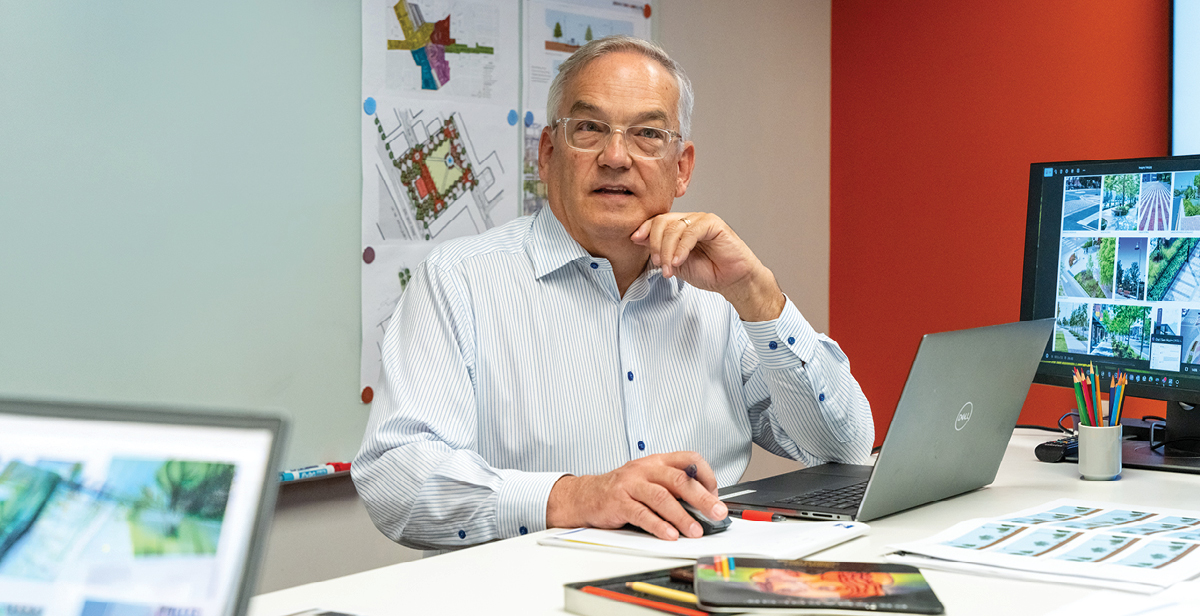
BGE Senior Landscape Architect David Retzsch, PLA, ASLA, brings over four decades of technical depth and civic purpose to every project — from historic Texas streetscapes to the expanding edges of some of America’s fastest-growing cities.
David Retzsch’s path into landscape architecture began long before he knew the profession existed. Growing up in rural Minnesota, he learned to read the land the way some kids learn to read books — noticing how water moved across fields, how tree groves created distinct places, and how soil changed underfoot. These early observations formed an intuitive understanding of natural systems.
A junior high drafting class added structure to that intuition. By high school, he was producing architectural illustrations with a level of precision that hinted at his future in the design field. But the defining moment came when he and his mother discovered landscape architecture in a University of Illinois course catalog. It was the first time he saw a discipline that merged environmental systems, design logic, and problem-solving at a civic scale. It wasn’t a career decision; it was a realization that the work he was already drawn to had a name.
A Practice Built on Integrated Problem-Solving
Throughout his career, David has gravitated toward environments where disciplines collaborate early and often. He believes the best solutions emerge when engineers, planners, architects, and landscape architects work as a single, complementary system — not as isolated contributors.
That’s why BGE felt like a natural fit when he joined five years ago. The firm’s multidisciplinary structure, intentional growth, and shared commitment to technical excellence and one firm mindset aligned seamlessly with his approach. And because he had already collaborated with BGE colleagues, Brian Reinhart, Brett Mann, and Michael Garrison, joining the firm felt less like a transition and more like stepping into a familiar workflow.
Louisiana Street: A Corridor Rebuilt with Precision
The Louisiana Street Reconstruction in McKinney puts that philosophy on full display. David first encountered the corridor years earlier, working on an early version alongside BGE’s Brian Reinhart while running his own firm. When both later joined BGE, the project returned, this time with greater scope, greater complexity, and higher community purpose.
Sitting at the intersection of McKinney’s historic identity and its accelerating development pressures, the corridor required solutions that respected its character while meeting modern performance standards. David led the construction documents and observation efforts, guiding the project from concept to built form. His work involved developing streetscape solutions that preserved the existing streetscape geometry, selecting materials engineered for durability and contextual fit, integrating landscape elements that softened infrastructure without compromising function, and designing pedestrian improvements that enhanced safety, walkability, and the emerging east downtown identity. The result is a corridor that honors its past while supporting the city’s future.
North Central Expressway: A Test of Technical Endurance
If Louisiana Street represents the satisfaction of a well-executed project, the North Central Expressway Urban Design project in Dallas represents something more demanding: technical endurance over time.
This TxDOT engagement spanned eight years and required coordination across five engineering teams. The project demanded clarity amid shifting design conditions, rigorous navigation of agency review processes, continuous recalibration of technical solutions, and disciplined communication across multidisciplinary teams. As Project Manager, David managed the full weight of that complexity. When the project concluded, what remained wasn’t just a completed design — it was the confidence, earned through sustained challenge, that he could bring structure, design clarity, and technical precision to any assignment placed in front of him.
The Urban Future: Where Landscape Architecture Leads
Looking ahead, David watches American cities with a technical eye — their density, their infrastructure pressures, their need to remain livable as they grow. He sees landscape architecture becoming increasingly central to that challenge. Not as an aesthetic overlay, but as a core planning and design discipline.
Too often, landscape architecture is still mistaken for “landscaping” — a narrow view that reduces the profession to beautification or planting design. David knows the reality is far broader. At its best, landscape architecture is an all-encompassing practice that touches every component of a site, often in close collaboration with engineers, architects, and planners. In the public realm, especially, it is a holistic approach to designing and implementing parks, trails, streetscapes, plazas, natural areas, and the connective tissue between public and private spaces.
As urbanization accelerates, this broader definition becomes even more critical. Cities are facing mounting technical demands — stormwater systems integrated into constrained corridors, zoning compliance, heat island effects, user safety, value creation, and long-term material performance — but they are also facing a human challenge: creating places where people genuinely want to be. That is where the concept of placemaking comes into play. Though the term has gained traction in recent years, its principles have always been embedded in landscape architecture. True placemaking is not superficial; it emerges from careful analysis of context, thoughtful integration of natural and built systems, and design strategies that create a strong sense of place through multidisciplinary collaboration and coordination.
“Bringing nature into the urban environment, at all kinds of scales to enhance functional outcomes, is where I see the future.”
David Retzsch, PLA, ASLA
It’s a vision fully aligned with BGE’s mission to build communities that are resilient, connected, and designed around people.
A Practice Defined by Precision and Purpose
Today, David Retzsch continues to help shape BGE’s landscape architecture practice with the same combination of qualities that has defined his career from the beginning: curiosity that doesn’t diminish, craft that keeps sharpening, and a deep, consistent belief that the places we build matter — to the communities that inhabit them and to the professionals responsible for getting them right. His work and his character, in the end, are the same thing. Like the landscapes he designs, both are built to last.
About BGE, Inc.
For 50 years, BGE, Inc. has served public and private clients as a full-service, multidiscipline engineering consulting firm with integrated capabilities. BGE delivers a broad range of advisory services, technical expertise, and innovative, sustainable solutions to support local, regional, and national communities as they shape the future of infrastructure. Backed by five decades of civil engineering leadership, BGE helps client partners solve their most critical challenges. For more information,https://www.bgeinc.com/